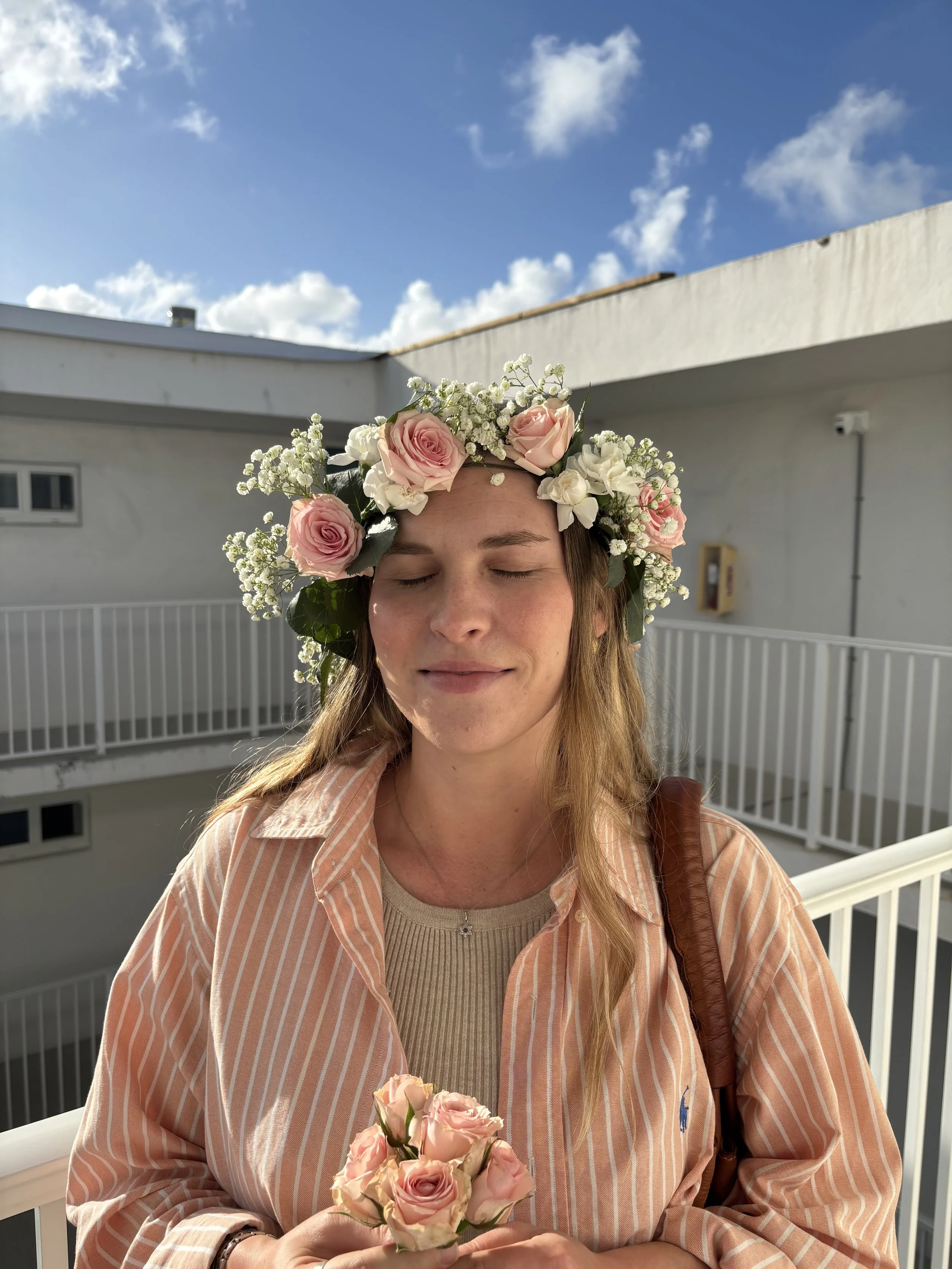
It took me a long time to tap into the wisdom of Purim. On the surface, it seems like a frivolous holiday. People dress in costumes and go out partying at all hours. In fact, heavy drinking is encouraged and rewarded. It’s pure debauchery, so you can understand why I resisted calling it holy. I even used to dislike it, labeling it as destructive and over-indulgent. But these last two Purim cycles, something changed in me. The chords of clarity played their tune, my internal mask revealed itself, and I finally saw the truth. Purim is, as it turns out, incredibly powerful. Once I put down my judgements and read between the lines, I started to appreciate the seriousness of the holiday, to see the hidden meaning behind its strange traditions. And this is really what Purim is all about: hidden truths.
The name אֶסְתֵּר (Esther) comes from the same root as the word for hidden or concealed, נסתר (Nistar). There are many interpretations about this, the obvious being that she hid her true identity from King Achashverosh (her husband), who did not know she was Jewish. Another is that God’s hand is hidden from this story, as his name is not mentioned once. To remind us that things are not always what they seem. That just because God was not mentioned, doesn’t mean he wasn’t present. He was there the whole time, hidden in the shadows but ever-omniscient. To show that part of keeping the faith means trusting ourselves and our own intuition. That sometimes the things which seem bad on the surface might actually be for the greater good. Like what is happening in Israel right now.
Events in Israel seem to always clearly mirror the Jewish calendar, with a resonance that continuously reaffirms my own faith. Like the sound of a ballistic missile hitting a building. Once you hear it, it rings in your body and your memory long after it’s over. And yet, despite the war with Iran, Israelis are still dancing in bomb shelters, remembering the story of Esther and Mordechai with more zeal than ever before. Because it is the nature of Jews to persist, to take matters into their own hands, yet still keeping faith in God whether divine presence is obvious or not. Believing in the good times is easy, but to believe when things are uncertain is the true test of faith. In the Purim story, the Jewish nation did not sit around waiting for a miracle, but instead took matters into their own hands to save themselves from an evil force. They didn’t know if they would win, but they still believed it was possible. And so we continue to dance no matter what is happening around us. THAT is purim. A dance embracing both the dark and the light as one. Like, yeah we’re at war, but we’re all together hanging out and it’s Purim. Might as well dance.
Some say Purim reveals our shadow side. The costume we wear is a mirror for the alter ego, the darker parts of ourselves that are always there, but hidden beneath the surface. Because we don’t want to face them. Or we can’t. It’s uncomfortable to look at these parts of ourselves. But this is where the wisdom of Purim becomes helpful. When you do it with intention, putting on a mask becomes symbolic. It teaches us how how to dance with our unfavorable traits, to merge both our light and dark parts together as one. Because one cannot exist without the other. The Purim story could not exist without Haman. Without him, Esther and Mordechai would not have been given the opportunity to rise up and save the Jewish nation, to level up their souls. It’s why it’s encouraged to drink until you cannot distinguish the difference between good (Mordechai) and evil (Haman). To remind us that where God is present, there is no difference - it all becomes one. It’s not about the contrast, it’s about the unity. On the spiritual plane, everything is for the good, הכל לטובה. When you unmask these hidden truths, there is really no clarity like it. In a very unobvious way, it all starts to make sense. Woah Purim!!!
Esther’s character really inspires me. I learned more about her last Purim in Jerusalem, when I heard a speech about the power of a woman’s intuition, and how Esther’s ability to listen to hers is what saved the Jewish nation from destruction. To me, Esther represents the divine feminine in its purest form. She was a young girl who didn’t want to marry the king, but kept her faith in God and did it anyway. She was pushed out of her comfort zone, but always stayed true to herself. At just the right moment, she makes the decision to reveal her true identity and call out the injustice of Haman’s decree. Although risky, she setup everything perfectly so that the King would be inclined to honor her boundaries. It was her idea to hold a banquet, her idea to ask the Jews to fast the night before to call in the support of God. She stood strong in her inner knowing when it mattered most, which is not only what saved herself, but the entire Jewish nation. A reminder that when women follow their intuition, it benefits the whole world. That we can channel our own divine power at any moment. That when we tap into our deepest inner knowing, it is God’s presence shining through.
Embodying the divine feminine means taking things slow, not rushing. Slow and steady. Letting things come to you. Soft, but strong. The Purim story spans 11 years, which means Esther waited patiently and diligently to fulfill her destiny. The profane masculine contrast is urgency: taking, conquering, violence. It is the energy of war, which is what would have happened if Esther had not intervened. This is why the divine feminine influence is so crucial: it keeps the world in balance. Which brings me to the point of all of this, to the light I am praying for during this turbulent time in Israel.
Like Mordechai and Achashverosh, may our men step into their divine masculine, so they are able to see the beautiful female power of protection. May they evolve enough to truly understand what could be when they enter the space of the divine feminine. My prayer for the women is for every woman to know her power. As a friend put it so eloquently: “May the feminine voice come back into the world with deep resonance and influence. Intuition is God shining through. May we remember that God is always present, even when it feels like he’s not. May we all have the tools (space, time, safety) to be open enough to channel our own intuition, knowing, and divine power. To find our inner peace. May we be bold enough to speak out on injustices in the world through and on behalf of our souls.”
Most importantly, may we all be able to dance with the darkness and the light as one, to put forth our own desires into the world, then step back and surrender to divine messages, like Esther. May we all tap into the highest parts of ourselves, our humblest parts, and remember that it is only when we get to the place of no knowing that our truest inner knowing shines through.